Building a well site pad: clearing, grading and access roads
A pad is only as good as the dirt work under it. Here is the order the work runs in and where projects tend to go wrong.
October 14, 2026 · 4 min read
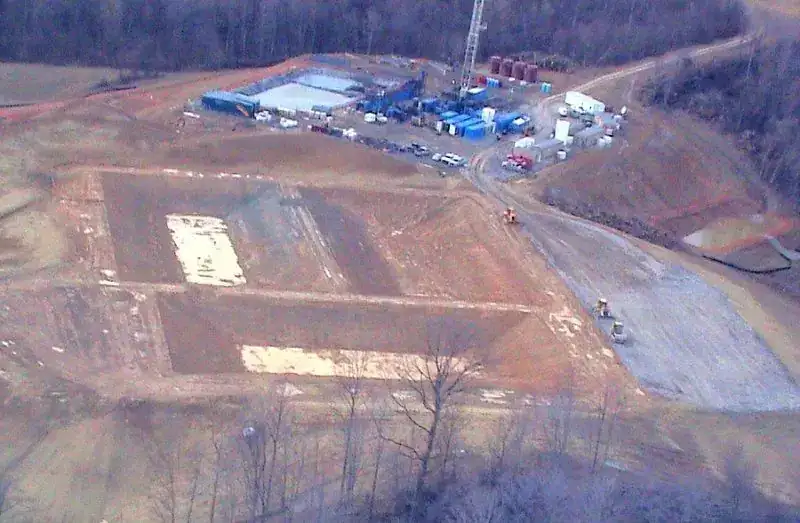
A well site pad looks simple from the road. It is a flat, hard surface in the middle of a hillside. Getting it flat and hard, and keeping it that way through a wet Pennsylvania winter with heavy rigs and trucks on it, is where the real work is. If you are a landowner leasing ground or an operator scheduling a pad, this is how the dirt work usually runs.
Clearing and grubbing first
Before anything gets graded, the site has to be cleared. Clearing takes the trees and brush. Grubbing takes the stumps and roots out of the ground, because wood left under a pad rots, and rotting wood means settling. Timber has to go somewhere, topsoil has to be stripped and stockpiled, and all of it needs a plan before the first cut. A crew that rushes this step pays for it later.
Earthmoving and grading
On sloped ground a pad is built by cutting into the high side and filling the low side. The goal is to balance the two so you are not hauling thousands of yards of dirt in or out. Grading then shapes the surface to a plan: flat enough to work on, with just enough fall to move water away from the equipment instead of under it.
Water is the thing to respect. A pad that holds water turns into soup, and soup does not carry a rig. Good grading is mostly drainage in disguise.
Compaction, stabilization and drying
Fill that is dumped and left alone will settle. Soil compaction is how you prevent that: fill goes down in layers, and each layer is rolled until it is tight before the next one goes on. Skip the layering and compact only the top, and the loose material underneath finds a way to move once the load arrives.
Wet ground makes all of this harder. Soil that is too wet will not compact, it just pumps under the roller. That is where soil drying and soil stabilization come in. Drying means opening the material up and letting it shed moisture, or working it so it can be placed. Stabilization improves weak ground so it can carry traffic. Both are common on well pad projects in this part of the state, where clay and springs are a fact of life. SCI handles earthmoving, soil compaction, soil stabilization and soil drying as part of its site development work.
Access roads
The pad does no good if trucks cannot get to it. An access road for this kind of work has to handle loaded trucks and heavy equipment, in rain and in thaw. That means a properly shaped base, ditches that carry water off the road, and culverts where the road crosses a drainage path. Road grade matters too. A grade that looks fine on a dry day can stop a loaded truck on a slick one.
It is worth thinking about the road's afterlife. Once drilling is done, a landowner may want the road kept for access, or reclaimed. Decide that before it is built, because it changes how it gets built.
Holding ponds and tank construction
Many sites need water storage, and that means a holding pond. Pond excavation is its own piece of dirt work: the right footprint, stable side slopes, and a liner or sealing approach that matches the plan. Get the dimensions and slopes wrong and you are digging it twice.
CST tank construction is also part of the site development scope at SCI. Tanks need a level, well-compacted, well-drained base, which brings us back to the compaction and grading discussed above. The foundation of a tank is just more good dirt work.
What to line up before the dozers show up
- Permits and approvals, confirmed with the county conservation district and the operator's own paperwork
- Erosion and sediment controls planned for the whole disturbed area, not added after the first storm
- A haul route for trucks that does not tear up a township road
- A plan for any coal seam or rock you might hit, since both are common here
Coal is a good example of the last point. If a seam turns up in the cut, the contractor that can remove and process it is already on your site. SCI does coal removal for the oil and gas industry and also builds the pads, roads and ponds. That keeps one phone number on the job instead of three.
Planning a pad or a development site
Shallenberger Construction, Inc handles site preparation for private and commercial land development and for the gas and oil industry, including well site pads, access roads and holding ponds. The Site Development page lists the full scope, from clearing and grubbing to retaining walls and sewer and water lines. To talk through your site, call (724) 628-8408. Quotes are free.
Shallenberger Construction, Inc, (724) 628-8408
Call (724) 628-8408More articles
What happens to the coal under your development site
Old waste piles, settled ground and surprise seams are common in Southwestern Pennsylvania, and how the coal gets processed decides what the property owner is paid.
Silt sock vs silt fence on Pennsylvania slopes
Both products hold back dirt. The difference shows up on steep ground, in wet weather and when the inspector arrives.